24 Jul 2026 · Updated 19 Oct 2026
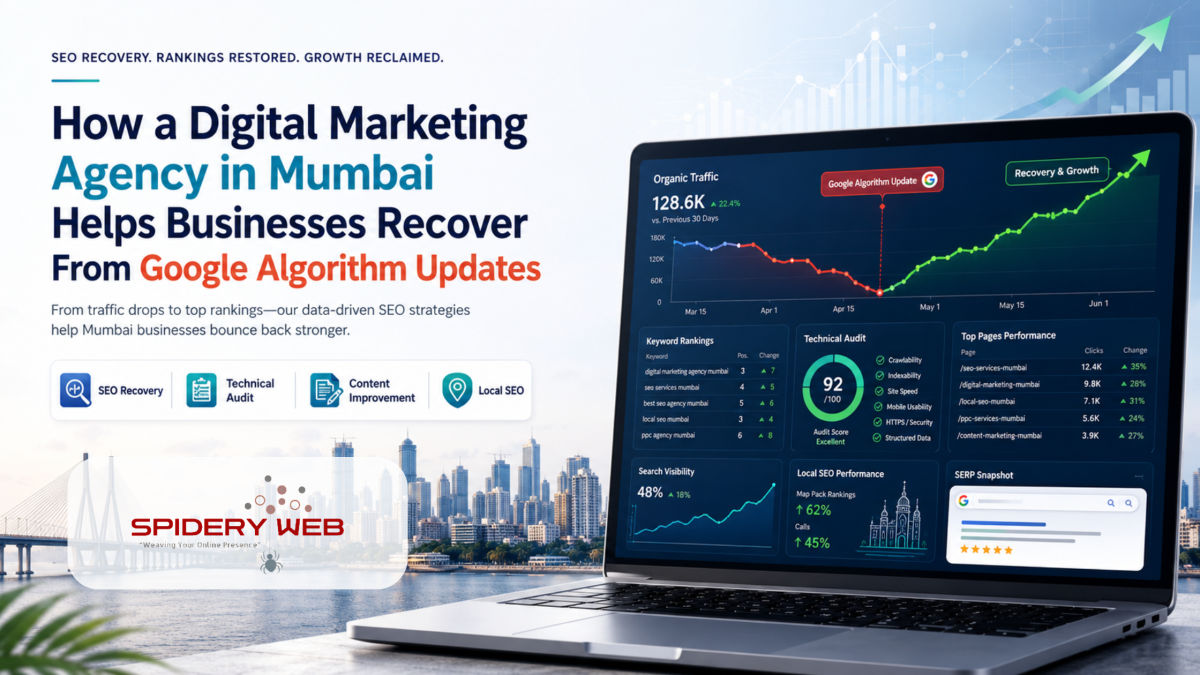
A sudden fall in website traffic can be stressful. One week, your website may be generating calls, enquiries and sales. The next week, your important keywords may disappear from the first page of Google.
When this happens, many business owners immediately assume that Google has penalised their website. However, a ranking drop can have several causes. It may be connected to a Google algorithm update, technical SEO problems, changing search intent, stronger competitors, poor content quality or tracking errors.
Want ChatGPT and Google AI Overviews to recommend your business? See our AI SEO services — or get a free proposal from Spidery Web.
An experienced Digital Marketing Agency in Mumbai does not start by changing everything on the website. It first studies the data, identifies the real reason for the decline and prepares a structured recovery plan.
For businesses in Malad and other parts of Mumbai, this process may include a technical SEO audit, content improvement, local SEO correction, backlink analysis, Google Search Console review and conversion tracking. The goal is not only to recover lost rankings. It is to build a stronger website that can perform more consistently in Google Search, AI Overviews and other AI-powered search platforms.
How Can an Agency Recover Lost Google Rankings?
A Digital Marketing Agency in Mumbai helps a business recover from a Google algorithm update by comparing traffic before and after the decline, identifying affected pages, checking technical and indexing problems, reviewing content quality, analysing backlinks, improving E-E-A-T signals and monitoring recovery through Google Search Console.
Google explains that core updates are broad changes intended to improve the quality and relevance of search results. They do not target individual websites or pages as direct penalties. Therefore, recovery normally requires improving the website as a whole rather than searching for one quick fix.
Key Takeaways
- A ranking decline is not always a Google penalty.
- The first step is to confirm when the traffic or ranking loss started.
- Technical, content, authority and user-experience issues must be reviewed together.
- Pages should be improved according to user intent, not only keyword density.
- Local businesses must also check their Google Business Profile and local rankings.
- Recovery can take time because Google must recrawl and reassess updated pages.
- No honest SEO agency in Mumbai can guarantee a specific ranking or recovery date.
- Strong SEO foundations can also improve eligibility for Google AI features and other AI search platforms.
What Is a Google Algorithm Update?
Google makes different types of updates. Some are broad changes to its core ranking systems. Others focus on spam, reviews or specific parts of the search experience.
A core update may change how Google evaluates factors such as:
A Google algorithm update is a change to the systems Google uses to crawl, understand, evaluate and rank online content.
- Content usefulness
- Search intent satisfaction
- Website trust
- Page experience
- Subject expertise
- Originality
- Relevance
- Link quality
- Overall website value
A website may lose visibility even when it has not received a manual penalty. Google may simply decide that other pages now provide more useful, relevant or trustworthy answers.
This is why effective Google core update recovery begins with analysis rather than panic.
Why Do Website Rankings Drop After Google Updates?
There is rarely one universal reason. Two websites affected by the same update may have completely different problems.
1. Content No Longer Matches Search Intent
Search intent describes what a person actually wants when entering a query.
For example, someone searching for “SEO agency in Mumbai” may want to compare service providers. A page that only explains the definition of SEO may not meet that commercial intent.
Google may favour pages that provide:
- Clear service information
- Relevant experience
- Case studies
- Transparent processes
- Local context
- Answers to common client questions
- Strong proof of expertise
When a page does not answer the real question behind the keyword, its rankings may decline.
2. Thin or Repetitive Content
Many websites create separate pages for closely related keywords but publish almost identical information on each page.
Examples include:
- SEO agency in Malad
- SEO company in Malad
- SEO services in Malad
- Best SEO agency in Malad
Creating four weak pages with repeated content may not provide more value than one complete, well-structured page.
Thin content may include:
- Very short service descriptions
- Generic AI-generated paragraphs
- Repeated location pages
- Pages created only to target keywords
- Blogs without practical advice
- Content copied or lightly rewritten from competitors
- Pages with no original examples or expert insight
Google recommends creating helpful, reliable, people-first content that provides real value. It also advises site owners to consider the overall page experience rather than focusing on one isolated ranking factor.
3. Outdated Information
A page that ranked well two years ago may no longer be the best answer today.
Outdated information may include:
- Old statistics
- Expired offers
- Outdated SEO practices
- Incorrect service details
- Former team members
- Broken external references
- Old screenshots
- Recommendations based on discontinued tools
An SEO company in Mumbai should identify which pages need updating, merging, redirecting or removing.
4. Weak Website Trust Signals
Google and users both look for signs that a business is genuine and trustworthy.
A website may struggle when it lacks:
- A clear About page
- Author information
- Business contact details
- Service-area information
- Customer reviews
- Relevant qualifications
- Case studies
- Editorial policies
- Privacy and legal pages
- References to reliable sources
These elements support E-E-A-T: experience, expertise, authoritativeness and trustworthiness.
5. Technical SEO Problems
A valuable page cannot perform well if search engines cannot crawl, render or index it properly.
Technical problems can include:
- Important pages blocked in
robots.txt - Accidental
noindextags - Incorrect canonical tags
- Broken internal links
- Redirect chains
- Duplicate URLs
- XML sitemap errors
- Slow server response
- Mobile usability problems
- JavaScript rendering issues
- Structured data errors
- Large numbers of orphan pages
- Incorrect status codes
A technical SEO agency in Mumbai checks whether search engines can access and understand every important page.
6. Poor Page Experience
Page experience is not only about achieving perfect scores in a testing tool. It includes the complete experience a visitor has on the website.
A page may disappoint users when it has:
- Slow loading
- Intrusive pop-ups
- Unstable page elements
- Small mobile text
- Difficult navigation
- Confusing menus
- Too many advertisements
- Unclear calls to action
- Poor visual hierarchy
Core Web Vitals are used by Google’s ranking systems, but Google also makes it clear that good scores alone do not guarantee high rankings.
7. Low-Quality or Manipulative Links
Backlinks can support authority when they come from relevant and trustworthy websites. However, poor link-building campaigns may create risk.
Warning signs include:
- Links from unrelated websites
- Paid links created only for ranking
- Repeated exact-match anchor text
- Links from spam pages
- Large volumes of low-quality directory links
- Private blog network links
- Automated comment links
A professional agency should conduct a quality backlink audit before deciding whether any action is required.
8. Stronger Competitors
Sometimes your website has not become worse. Competing pages have simply become better.
A competitor may have added:
- More complete content
- Better expert commentary
- Original research
- Helpful tools
- Stronger local relevance
- Improved page speed
- Better internal links
- Updated service information
- More credible backlinks
A ranking recovery plan should therefore compare affected pages with the pages now performing above them.
Google Core Update vs Manual Penalty
These terms should not be used as if they mean the same thing.
| Point | Google Core Update Impact | Manual Penalty |
|---|---|---|
| Cause | Broad reassessment by ranking systems | A reviewer identifies a policy violation |
| Notification | Usually no direct notification | Usually visible in Search Console |
| Main response | Improve overall quality and relevance | Fix the stated violation and request review |
| Recovery timing | Depends on recrawling and reassessment | Depends on correction and reconsideration |
| Common mistake | Searching for one technical fix | Ignoring the manual-action message |
A Google ranking drop recovery strategy must first identify which situation applies. Treating a broad algorithmic decline like a manual penalty can waste time and resources.
How a Digital Marketing Agency in Mumbai Diagnoses the Ranking Drop
A reliable agency begins with evidence.
Step 1: Confirm the Date of the Decline
The agency checks:
- When clicks started falling
- When impressions declined
- Which pages lost visibility
- Which keyword groups were affected
- Whether conversions also declined
- Whether the fall was sudden or gradual
This information may come from:
- Google Search Console
- Google Analytics
- Bing Webmaster Tools
- Rank-tracking software
- CRM or lead records
- Call-tracking reports
- Website server logs
The decline date is then compared with website changes and confirmed ranking updates.
Step 2: Check Whether Tracking Is Working
Not every apparent traffic decline is an SEO decline.
Tracking problems may occur after:
- A website redesign
- A consent-banner update
- A Google Analytics change
- A tag-manager error
- A domain migration
- A form replacement
- A payment-gateway update
Before starting website traffic recovery, the agency checks whether visits, forms, calls and WhatsApp clicks are still being measured correctly.
Step 3: Segment the Loss
Looking only at total traffic can hide the real problem.
The agency separates performance by:
- Page
- Query
- Device
- Country
- City
- Search appearance
- Brand and non-brand searches
- Service category
- Blog category
- New and returning visitors
For example, a Mumbai company may discover that its overall traffic is stable, but visits to its main service pages have declined. That is more commercially important than a decline on low-value blog posts.
Step 4: Review Google Search Console
A detailed Search Console review examines:
- Click changes
- Impression changes
- Average position
- Click-through rate
- Indexing reports
- Crawl errors
- Manual actions
- Security issues
- Core Web Vitals
- Sitemap status
- Rich-result errors
If impressions dropped sharply, Google may be showing the pages less often. If impressions are stable but clicks fell, the problem may involve lower positions, weak titles, changing results or stronger competitors.
Step 5: Compare Affected and Stable Pages
A strong SEO audit service in Mumbai does not treat every page equally.
The agency compares:
- Pages that lost rankings
- Pages that remained stable
- Pages that improved
This comparison can reveal patterns.
For example:
- Old articles may have declined while recently updated articles remained stable.
- Generic service pages may have fallen while pages containing case studies improved.
- Desktop traffic may be stable while mobile visibility declined.
- One service category may have lost rankings because of content overlap.
Step 6: Review Search Intent and Competing Results
The agency manually studies current search results for important queries.
It asks:
- What page formats are ranking?
- Are service pages or guides performing better?
- Are users looking for local providers?
- Are comparison pages visible?
- Do top pages contain videos, tables or FAQs?
- Are Google Business Profiles appearing prominently?
- Is an AI Overview changing the search journey?
- Has the meaning of the query changed?
This prevents the team from optimising a page for an outdated version of search intent.
Complete Google Core Update Recovery Checklist
Technical SEO Checklist
A technical audit should cover:
- Website crawlability issues
- Website indexing problems
- Mobile usability
- Page speed optimisation
- Core Web Vitals
- Canonical tag issues
- Duplicate content problems
- Broken internal links
- XML sitemap errors
robots.txtrestrictions- Accidental
noindextags - Structured data errors
- Redirect chains and loops
- Orphan pages
- Website architecture
- Search Console indexing issues
- Server errors
- JavaScript SEO issues
- HTTP and HTTPS duplication
- Pagination and filter URLs
- Domain migration errors
Google’s Search Essentials state that pages must meet basic technical requirements, follow spam policies and apply key SEO practices to remain eligible for search visibility. Eligibility, however, does not guarantee crawling, indexing or ranking.
Content Quality Checklist
Every important page should be reviewed for:
- Clear search intent
- Original value
- Accurate information
- First-hand experience
- Expert contribution
- Complete topic coverage
- Useful examples
- Clear headings
- Natural language
- Supporting evidence
- Updated statistics
- Relevant internal links
- Helpful images or videos
- Clear next steps
- Duplicate or overlapping sections
- Unnecessary filler
- Strong local context where relevant
E-E-A-T Checklist
Check whether the website clearly communicates:
- Who created the content
- Why the author is qualified
- How the information was researched
- Whether claims are supported
- Who owns the business
- Where the business operates
- How customers can make contact
- What experience the company has
- Whether real examples are provided
- Whether customer feedback is authentic
Authority Checklist
The agency may examine:
- Relevant editorial backlinks
- Business citations
- Local citations
- Brand mentions
- Industry associations
- Customer reviews
- Digital PR opportunities
- Expert interviews
- Original research
- Case studies
- Link quality
- Suspicious link patterns
Step-by-Step Guide to Recover After a Google Algorithm Update
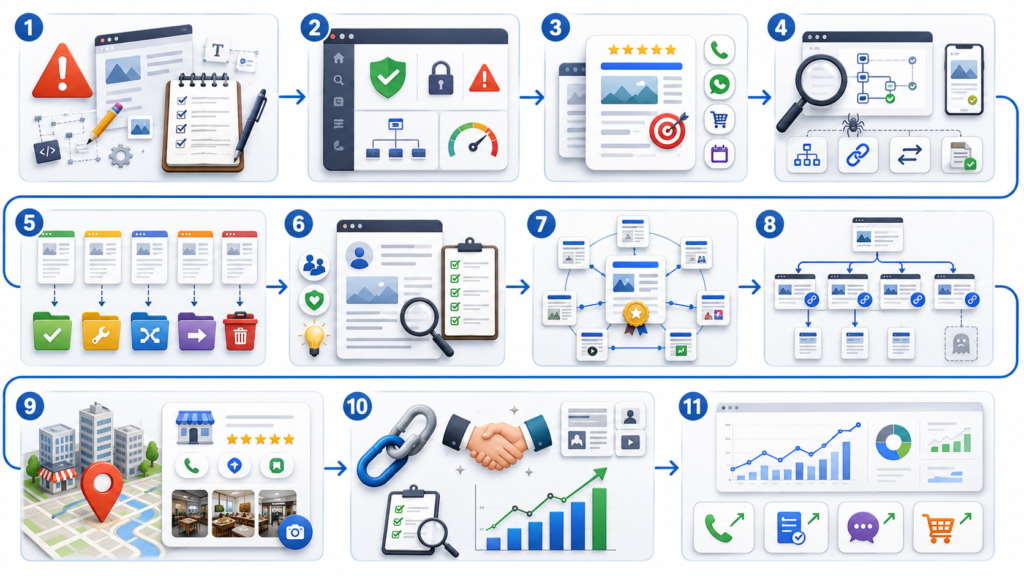
Step 1: Avoid Making Immediate, Unplanned Changes
A ranking decline creates pressure, but changing titles, content, URLs and website structure at the same time can make diagnosis more difficult.
First, record:
- The date of the decline
- The pages affected
- The keywords affected
- Recent website changes
- Current traffic and conversion levels
Keep a clear change log throughout the recovery process.
Step 2: Check for Manual Actions and Security Issues
Open Google Search Console and review:
- Manual Actions
- Security Issues
- Indexing
- Sitemaps
- Core Web Vitals
A hacked website, malware warning or manual action requires urgent attention and a different recovery process.
Step 3: Identify the Pages With the Greatest Business Impact
Do not begin with every low-traffic blog.
Prioritise pages that previously generated:
- Qualified leads
- Phone calls
- WhatsApp enquiries
- Bookings
- Purchases
- Distributor enquiries
- High-value organic traffic
For a local business, recovering a service page may be more valuable than restoring traffic to ten unrelated articles.
Step 4: Conduct a Full Technical SEO Audit
The agency should crawl the website and review its indexability, architecture, internal links, status codes and performance.
The audit should answer:
- Can Google access the page?
- Is Google indexing the preferred URL?
- Does the page load properly on mobile?
- Is the canonical tag correct?
- Is the page linked from relevant sections?
- Is duplicate content creating confusion?
- Has a redesign damaged important URLs?
- Are redirects passing users to the correct pages?
Step 5: Conduct a Content Audit
Each affected page can be classified as:
- Keep
- Improve
- Merge
- Redirect
- Remove
A content audit should not delete pages simply because their current traffic is low. A low-traffic page may still support customers, answer an important question or strengthen the wider topic cluster.
Improve a Page When:
- The topic is still relevant.
- The page has some impressions or backlinks.
- The information can be updated.
- Search intent still matches.
- The page supports a valuable service.
Merge Pages When:
- Several pages target the same intent.
- Content is repetitive.
- None of the pages is complete enough.
- Internal competition may be weakening relevance.
Remove or Redirect a Page When:
- The information is inaccurate.
- The service no longer exists.
- The page has no unique purpose.
- A stronger replacement page is available.
Step 6: Improve People-First Content
Helpful content should solve a real problem.
Instead of writing only:
“We are the best digital marketing agency in Mumbai and provide high-quality SEO services.”
Explain:
- How the audit is conducted
- Which data is examined
- What clients receive
- Which problems are commonly found
- How priorities are selected
- What cannot be guaranteed
- How results are measured
Google warns that using generative AI to produce large numbers of pages without adding value may violate its policy on scaled content abuse. AI tools can support research and structure, but the published page should include useful, accurate and original value.
Step 7: Strengthen Topic Authority
A single service page may not demonstrate complete expertise.
A search engine optimisation company in Mumbai can build a connected topic cluster around subjects such as:
- Google algorithm updates
- Technical SEO audits
- Search Console traffic drops
- Content audits
- Website migrations
- Local SEO recovery
- Core Web Vitals
- Duplicate content
- Website indexing
- E-E-A-T
- SEO for AI Overviews
- Google Business Profile optimisation
Each supporting article should answer a distinct question and link naturally to the main SEO recovery page.
Step 8: Improve Internal Linking
Internal links help users and search engines discover related pages.
Good internal linking should:
- Connect relevant articles and services
- Use descriptive anchor text
- Direct authority toward important pages
- Reduce orphan pages
- Help users continue their journey
- Support a clear website hierarchy
Avoid inserting the same exact-match keyword into every internal link.
Step 9: Improve Local SEO Signals
A business searching for an SEO agency in Malad may prefer a provider that understands local competition and customer behaviour.
Local recovery may involve:
- Updating the Google Business Profile
- Correcting the business name, address and phone details
- Selecting accurate categories
- Improving service descriptions
- Publishing genuine photos
- Responding to customer reviews
- Building consistent local citations
- Creating useful location pages
- Adding local case studies
- Tracking calls and direction requests
- Reviewing Google Maps rankings
A decline in organic rankings and a decline in local-map rankings may have different causes. Both should be analysed separately.
Step 10: Review Backlinks and Brand Authority
The agency should review whether the website has earned recognition from relevant sources.
A balanced authority strategy may include:
- Digital PR
- Expert contributions
- Industry directories
- Local business associations
- Useful research
- Original surveys
- Case studies
- Partnerships
- Interviews
- Reputable media mentions
The goal is not to build the largest number of links. It is to earn relevant signals that support the business’s real reputation.
Step 11: Monitor Recovery by Page and Conversion
Recovery should not be judged only by total traffic.
Monitor:
- Qualified organic leads
- Calls
- Form submissions
- WhatsApp clicks
- Bookings
- Sales
- Non-brand impressions
- Priority keyword visibility
- Local-map visibility
- Engagement with key pages
- Assisted conversions
A website may receive less overall traffic but generate more valuable enquiries after irrelevant traffic is reduced.
How SEO Recovery Supports AI Search Visibility
Businesses are no longer competing only for ten traditional blue links. Their content may also be discovered through Google AI Overviews, Google AI Mode, ChatGPT, Gemini, Perplexity, Claude and Microsoft Copilot.
However, there is no reliable shortcut that guarantees an AI citation.
Google states that its usual SEO best practices remain relevant for AI Overviews and AI Mode. There are no separate technical requirements or special optimisations needed purely to appear in these features.
Google’s guidance for generative AI search also says that foundational SEO, clear technical structure and unique, expert-led content remain important. It warns businesses not to depend on unsupported “AEO” or “GEO hacks.”
Practical AI Search Optimisation Actions
A digital marketing agency for AI search can improve discoverability by:
- Publishing direct answers to real questions
- Using descriptive headings
- Adding clear definitions
- Providing original examples
- Naming relevant entities accurately
- Supporting claims with credible sources
- Keeping important information updated
- Making pages easy to crawl
- Using structured data where appropriate
- Building a recognisable brand
- Creating consistent business information
- Adding author and reviewer details
- Publishing case studies and first-hand experience
ChatGPT Search Optimisation
OpenAI states that publishers should avoid blocking OAI-SearchBot when they want their pages to be discoverable and included in ChatGPT search summaries or snippets. Publishers that permit access can also track referral traffic from ChatGPT through analytics.
This does not guarantee that a page will be cited. It simply makes the content available for possible discovery.
Bing Copilot SEO
Bing’s webmaster guidelines cover discovery, crawling, indexing and visibility across Bing Search, Copilot and grounding results. Following the guidelines helps URLs remain eligible for indexing, ranking and citations.
Bing Webmaster Tools also provides an AI Performance report that can show citation and grounding activity across supported Microsoft AI experiences.
Traditional SEO, AEO and GEO: What Is the Difference?
| Approach | Main Focus | Typical Actions |
| SEO | Visibility in search results | Technical SEO, content, links and user experience |
| AEO | Clear answers for answer-based systems | Definitions, FAQs, concise answers and structured information |
| GEO | Visibility in generative search experiences | Original evidence, entity clarity, expert content and crawlability |
| Local SEO | Visibility for location-based searches | Google Business Profile, reviews, local pages and citations |
| Conversion Optimisation | Turning visitors into customers | Calls to action, forms, trust signals and tracking |
These methods should support one another. A page should not be written only for machines. It should first help the person searching for an answer.
Benefits of Hiring an SEO Recovery Agency in Mumbai
Faster Diagnosis
An experienced team can separate algorithmic changes from technical errors, tracking problems and seasonal demand.
Better Prioritisation
Not every issue has the same impact. An agency can focus first on the pages and problems most closely connected to revenue.
Access to Multiple Skills
Recovery may require collaboration between:
- SEO strategists
- Technical SEO specialists
- Content writers
- Developers
- Designers
- Analytics specialists
- Local SEO experts
- Conversion specialists
Local Market Understanding
A marketing agency in Malad, Mumbai can study how customers search across Malad, Goregaon, Kandivali, Andheri and other nearby business areas.
Stronger Content Quality
Professional content audit services can improve accuracy, usefulness, clarity and search-intent alignment.
Improved Lead Tracking
A full-service digital marketing agency in Mumbai can connect SEO performance with calls, forms, WhatsApp enquiries, bookings and sales.
Long-Term Risk Reduction
Recovery work can create better publishing standards, stronger technical processes and clearer quality checks for future content.
Common Mistakes Businesses Make After a Ranking Drop
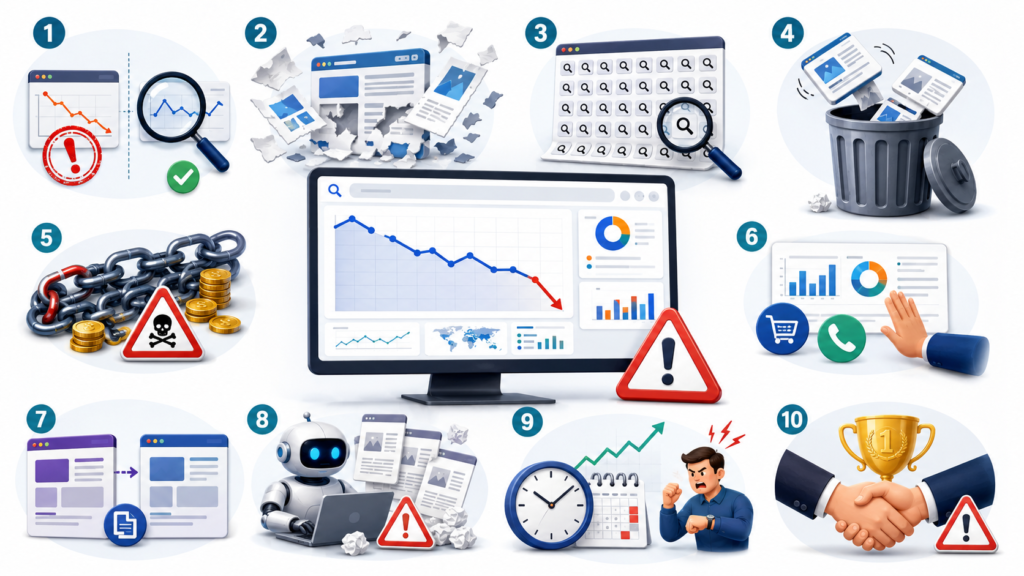
Mistake 1: Assuming Every Decline Is a Penalty
Core updates are not the same as manual penalties. Check the evidence before selecting a solution.
Mistake 2: Rewriting the Entire Website Immediately
Large uncontrolled changes can remove useful content and make it harder to understand what caused the decline.
Mistake 3: Adding More Keywords
Keyword repetition cannot solve weak intent, poor content, technical errors or low trust.
Mistake 4: Deleting Every Low-Traffic Page
Some pages support customer decisions, topical authority or long-tail visibility even when they attract limited direct traffic.
Mistake 5: Buying Large Numbers of Backlinks
Low-quality links do not replace useful content, technical stability or genuine authority.
Mistake 6: Ignoring Conversion Data
Traffic recovery is valuable only when it supports meaningful business outcomes.
Mistake 7: Copying the Current Top-Ranking Pages
Competitor research is useful, but copying their structure and points rarely creates distinct value.
Mistake 8: Publishing Unedited AI Content
AI-generated text may contain generic claims, repetition or factual errors. Every page needs expert review and real business insight.
Mistake 9: Expecting Recovery in a Few Days
Updated pages must be crawled, indexed and reassessed. Competitive improvement also takes time.
Mistake 10: Choosing an Agency That Guarantees Rankings
Google does not accept payment for higher organic rankings and does not guarantee that any compliant page will be crawled, indexed or served.
Case Study Example: Local Service Business in Malad
Consider a fictional physiotherapy clinic in Malad.
The clinic previously received organic enquiries from pages targeting back pain treatment, sports rehabilitation and physiotherapy services. After a broad search update, its non-brand clicks fell by 42%.
Initial Findings
The website traffic drop analysis found:
- Several service pages had almost identical content.
- Blog articles were outdated.
- Doctor qualifications were not clearly displayed.
- Important pages had weak internal links.
- Mobile loading was slow.
- Local business information was inconsistent.
- Some pages competed for the same keywords.
- Form submissions were not tracked correctly.
Recovery Actions
The agency:
- Merged overlapping service pages.
- Added medically reviewed content.
- Displayed the physiotherapist’s qualifications and experience.
- Updated old articles with safer, clearer information.
- Improved internal links between conditions and treatments.
- Compressed images and improved mobile speed.
- Corrected local citations.
- Updated the Google Business Profile.
- Added clearer booking calls to action.
- Configured form, phone and WhatsApp tracking.
Illustrative Outcome
Over the following months, the clinic began recovering non-brand impressions for important service searches. Its total traffic remained slightly below the earlier peak, but qualified appointment enquiries increased because the improved pages matched patient needs more effectively.
This example is illustrative. Actual recovery depends on the website, market, competition, technical condition and scope of the update.
Statistics to Include Before Publication
Add verified, current data where it improves the article. Do not publish invented statistics.
| Suggested Data Point | Recommended Source |
| Percentage of website traffic coming from organic search | Verified analytics report or industry research |
| Change in mobile search behaviour in India | Google or a recognised research organisation |
| Local-search conversion behaviour | Google or credible local-search research |
| Core Web Vitals performance | Google Search Console or Chrome UX Report |
| Organic lead contribution | Your own GA4, CRM and call-tracking data |
| Recovery improvement | An anonymised Spidery Web case study |
Original business data can be especially valuable because it gives readers information that is not available on hundreds of competing websites.
Expert Insights From an SEO Recovery Perspective
Recovery Is Usually a Website-Wide Quality Project
A core update may expose weaknesses that were already present. These can include outdated pages, weak expertise signals, poor internal linking or unclear service positioning.
Traffic Alone Is Not the Final Goal
The correct question is not only, “Did traffic return?”
It is also:
- Did qualified leads return?
- Are the right service pages visible?
- Are visitors taking action?
- Is the business attracting relevant customers?
- Can performance be measured accurately?
Local Context Must Be Real
Adding “Mumbai” or “Malad” repeatedly does not create local relevance.
Useful local content may include:
- Areas served
- Local customer questions
- Location-specific case studies
- Travel or access details
- Relevant service limitations
- Genuine customer reviews
- Accurate business information
Recovery Work Should Be Documented
Keep a record of:
- Pages changed
- Technical fixes
- Content updates
- Redirects
- Internal links
- Publishing dates
- Indexing status
- Performance changes
Without documentation, it becomes difficult to learn which actions created improvement.
SEO, GEO and Conversion Strategy Should Work Together
Ranking for a keyword is only one stage. The page must also be clear enough to appear useful in AI-generated answers and persuasive enough to convert visitors into enquiries.
Choosing the Best Digital Marketing Agency in Mumbai for SEO Recovery
The phrase best digital marketing agency in Mumbai is subjective. The right agency is the one that understands your business model, website history, customer journey and commercial priorities.
Before hiring an agency, ask:
- Will you review Search Console and analytics data?
- How will you identify the decline date?
- Will you check tracking before diagnosing the problem?
- Which pages will you prioritise?
- How will you evaluate content quality?
- Do you provide technical SEO services in Mumbai?
- How will you measure recovery?
- Will you track leads and sales?
- How often will you report progress?
- What results can you not guarantee?
- Will developers and content specialists work together?
- How will you improve visibility across traditional and AI search?
Avoid agencies that offer the same recovery package to every business. Effective digital marketing consultants’ services should be based on evidence, not a fixed list of activities.
Frequently Asked Questions
1. What is a Google algorithm update?
A Google algorithm update is a change to the systems Google uses to understand, evaluate and rank content. Some updates are broad core updates, while others focus on spam or particular search systems. A website can gain or lose visibility when Google reassesses which pages provide the most helpful and relevant results.
2. Why do website rankings drop after a Google core update?
Rankings may drop because competing pages now match search intent better, your content has become outdated, the website has technical problems or the page lacks originality, expertise or trust. A decline does not automatically mean that Google has penalised the website.
3. Can a website recover from a Google algorithm update?
Yes, a website can recover, but recovery is not guaranteed. The business must identify the real weaknesses, improve affected pages, fix technical issues and strengthen the overall website. Google then needs time to crawl and reassess the changes.
4. How long does Google core update recovery take?
There is no fixed recovery period. Minor technical problems may show improvement after pages are recrawled, while wider content and authority improvements may take several months. Recovery depends on the severity of the issues, competition and how quickly search systems reassess the website.
5. How can an SEO agency identify the reason for a traffic drop?
An agency compares Search Console, analytics, ranking, indexing and conversion data before and after the decline. It also reviews website changes, technical problems, affected page groups, search intent, competitor improvements and confirmed ranking updates.
6. Is a Google core update the same as a manual penalty?
No. A core update is a broad algorithmic reassessment. A manual penalty occurs when Google identifies a specific policy violation and reports it in the Manual Actions section of Search Console. The recovery steps are different.
7. Should outdated website content be deleted or improved?
Improve content when the topic is still useful and the page has value. Merge it when another page serves the same purpose. Remove or redirect it when the information is inaccurate, the service no longer exists or a better replacement is available.
8. Can technical SEO help recover lost rankings?
Yes. Technical SEO can correct crawlability, indexing, canonical, mobile, speed, redirect and website-architecture problems. However, technical fixes alone may not recover a site when the main issue is weak content or poor search-intent alignment.
9. How does E-E-A-T affect Google rankings?
E-E-A-T helps content demonstrate experience, expertise, authority and trust. Businesses can strengthen these signals through accurate information, qualified authors, first-hand examples, transparent company details, customer evidence and reliable sources. E-E-A-T should be treated as a quality framework, not a single score.
10. How can a digital marketing agency in Mumbai help with SEO recovery?
A Digital Marketing Agency in Mumbai can audit the traffic decline, identify affected pages, fix technical problems, improve content, strengthen local SEO, review backlinks and track business results. It can also coordinate developers, writers and analytics specialists under one recovery plan.
11. What should a business do when website traffic suddenly drops?
First check tracking, Search Console, manual actions, security issues and recent website changes. Record the decline date and affected pages. Avoid making uncontrolled changes until the cause has been investigated.
12. Can local rankings drop after a Google update?
Yes. Local visibility may change because of competition, relevance, proximity, review activity, business information or changes to the website and Google Business Profile. Organic rankings and map rankings should be analysed separately.
13. Does adding more content guarantee recovery?
No. Publishing more pages can make the problem worse when the content is repetitive or unhelpful. Improve quality, intent and originality before increasing publishing volume.
14. Can an agency guarantee Google ranking recovery?
No ethical agency can guarantee a specific position, recovery percentage or date. An agency can complete evidence-based improvements and report progress, but search engines control crawling, indexing and rankings.
15. How can a website improve visibility in ChatGPT and other AI platforms?
Publish original, well-supported and clearly structured information. Keep pages crawlable, identify entities accurately, add expert insights and avoid blocking relevant search crawlers. These actions improve eligibility, but they do not guarantee citations.
Conclusion
A sudden decline in rankings can affect enquiries, sales and business confidence. However, rushed changes and quick SEO tricks rarely produce a stable solution.
Successful Google core update recovery begins with accurate diagnosis. The website must be reviewed across technical SEO, content quality, search intent, user experience, authority, local visibility and conversion performance.
A capable Digital Marketing Agency in Mumbai can bring these areas together under one practical recovery strategy. For businesses in Malad and across Mumbai, the right partner should explain what changed, which pages matter most, what needs improvement and how progress will be measured.
The goal should not be to return to an old ranking at any cost. It should be to create a more useful, trustworthy and technically reliable website that can earn visibility across Google Search, Google AI experiences, ChatGPT, Gemini, Perplexity and Microsoft Copilot.
Has your Google ranking suddenly dropped? Are impressions, organic leads or website enquiries decreasing?
Spidery Web, a digital marketing agency in Malad, Mumbai, helps businesses investigate ranking losses and build structured SEO recovery plans. Our approach can include technical SEO audits, content audits, local SEO, website ranking recovery services, analytics review and conversion tracking.
Contact Spidery Web to discuss your website’s performance and identify the next practical steps toward stronger organic visibility.