14 Jul 2026 · Updated 19 Oct 2026
Choosing a marketing agency can feel confusing.
Almost every agency talks about creativity, reach, growth and results. Some promise better Google rankings. Others focus on social media, paid advertising, websites or lead generation. With so many options available, how do you identify the agency that is genuinely suitable for your business?
The best choice is not always the biggest agency, the cheapest agency or the company with the most attractive presentation. It is the agency that understands your goals, audience, industry, sales process and budget and can turn those insights into a measurable digital marketing strategy.
A reliable digital marketing agency in Mumbai should help your business attract the right audience, generate qualified enquiries, improve conversions and understand where your marketing budget is going. It should also communicate honestly about what is working, what needs improvement and what results can realistically be expected.
This guide explains how to choose the best digital marketing agency in Mumbai, what to check before signing a contract, how to compare proposals and which warning signs you should avoid.
Table of Contents
- What does a digital marketing agency do?
- Why the right agency matters
- Define your business goals
- Identify the services you need
- Review the agency’s experience
- Check case studies and client results
- Evaluate its strategy
- Compare pricing and deliverables
- Review tracking and reporting
- Check communication and transparency
- Understand account ownership
- Compare different types of agencies
- Questions to ask before hiring
- Common mistakes to avoid
- Final agency-selection checklist
- Frequently asked questions
What Does a Digital Marketing Agency Do?
A digital marketing agency helps businesses promote their products or services through online channels.
Depending on its capabilities, an agency may provide:
- Search engine optimization
- Local SEO
- Google Business Profile optimization
- Google Ads management
- Meta Ads management
- Social media marketing
- Content marketing
- Website development
- Landing-page creation
- Conversion-rate optimization
- Email marketing
- Marketing automation
- Online reputation management
- Analytics and campaign reporting
A full-service digital marketing agency in Mumbai combines several of these services into one coordinated strategy.
For example, SEO may help a business attract organic traffic, Google Ads may generate immediate enquiries, social media may improve brand awareness and remarketing may bring previous visitors back to the website.
The value comes from making these channels work together instead of operating them as unrelated activities.
Why Choosing the Right Digital Marketing Agency Matters
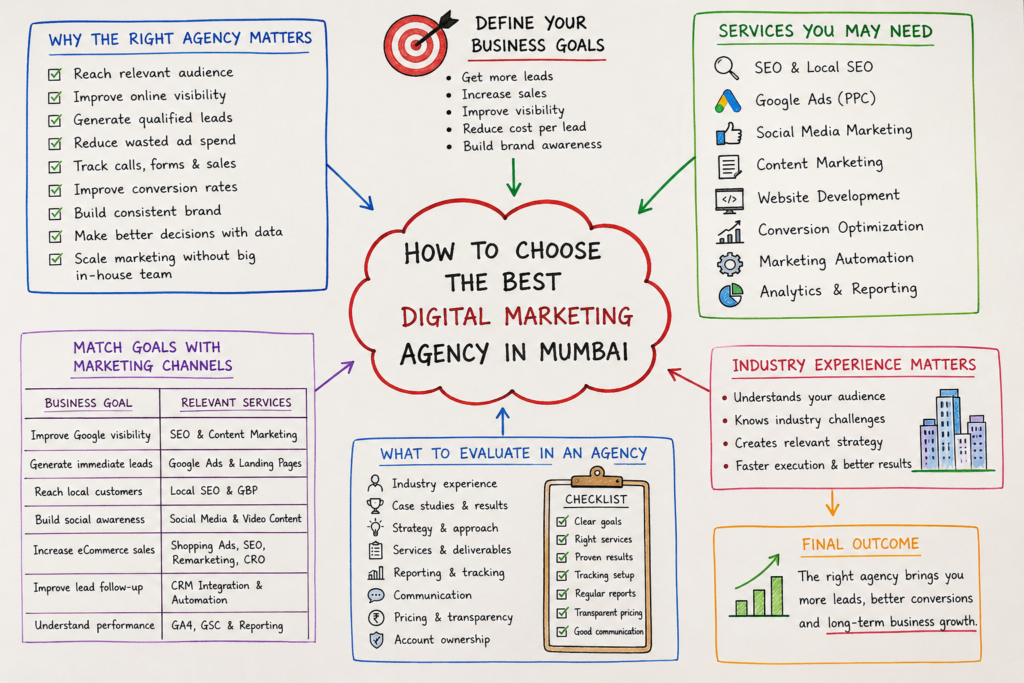
Hiring an agency is not only about outsourcing social media posts or improving website traffic. You are trusting an external team with your brand, customer data, advertising budget and online reputation.
The right agency can help you:
- Reach a more relevant audience
- Improve your online visibility
- Generate qualified leads
- Reduce wasted advertising spend
- Track calls, forms and sales
- Improve conversion rates
- Build a consistent brand presence
- Make better decisions using data
- Scale marketing without building a large internal team
The wrong agency may create activity without meaningful progress.
Your reports may show impressions, followers and clicks while your business continues to receive poor-quality leads. That is why you should evaluate an agency based on business outcomes, not vanity metrics alone.
Step 1: Define Your Business Goals Before Contacting Agencies
Before you begin searching for the best digital marketing agency in Mumbai, decide what you want marketing to achieve.
“Growing the business” is too broad. Convert it into clear goals.
Your goals may include:
- Generating qualified enquiries
- Increasing online sales
- Improving local search visibility
- Getting more calls from Google
- Launching a new product
- Reducing cost per lead
- Improving website conversions
- Building brand awareness
- Entering a new Mumbai market
- Automating lead follow-ups
Match Goals With Marketing Channels
| Business goal | Relevant services |
|---|---|
| Improve Google visibility | SEO and content marketing |
| Generate immediate leads | Google Ads and landing pages |
| Reach local customers | Local SEO and Google Business Profile |
| Build social awareness | Social media marketing and video content |
| Increase ecommerce sales | Shopping ads, SEO, remarketing and CRO |
| Improve lead follow-up | CRM integration and digital marketing automation services |
| Understand performance | GA4, Google Search Console and campaign reporting |
This step prevents you from paying for services that do not support your immediate priorities.
A local clinic may need Google Business Profile optimization and location-based search campaigns. A manufacturer may need B2B SEO, technical content and enquiry-focused landing pages. A real estate company may require paid advertising, call tracking, WhatsApp integration and rapid lead assignment.
The strategy should reflect the business model.
Step 2: Decide Which Digital Marketing Services You Need
Different agencies have different strengths.
One company may be an experienced SEO agency in Mumbai, while another may specialise in paid media. Some agencies focus on branding and social content. Others provide websites, performance marketing and automation under one roof.
Before hiring an agency, identify whether you need one specialised service or an integrated solution.
SEO Services
SEO may be suitable when you want sustainable visibility for relevant searches.
A professional SEO service can include:
- Keyword and competitor research
- Technical SEO audits
- On-page optimization
- Local SEO
- Content planning
- Internal linking
- Google Search Console analysis
- Authority-building activities
- Conversion optimization
- Performance monitoring
Be cautious when an agency guarantees a first-page position within a fixed period. Search visibility depends on competition, website quality, technical condition, content, authority and many external factors.
Google Ads and Performance Marketing
A Google Ads agency in Mumbai should do more than launch campaigns.
Its work may include:
- Search-intent research
- Campaign structure
- Keyword targeting
- Negative keywords
- Ad-copy testing
- Location targeting
- Landing-page recommendations
- Conversion tracking
- Bid and budget optimization
- Lead-quality analysis
- Remarketing
- Return on ad spend reporting
A capable performance marketing agency in Mumbai should connect ad performance with actual business enquiries and sales—not stop at clicks.
Social Media Marketing
A social media marketing agency in Mumbai may help with:
- Content strategy
- Reels and video concepts
- Static creatives
- Carousel posts
- Community management
- Paid campaigns
- Influencer collaborations
- Social reporting
- Brand consistency
Ask whether content creation, video shoots, editing, posting, comment management and paid promotion are included. The phrase “social media management” can mean very different things across proposals.
Website Development and Conversion Optimization
A website should not only look attractive. It should help visitors understand the offer, trust the business and take action.
A website development and digital marketing company in Mumbai should consider:
- Mobile usability
- Page speed
- Clear navigation
- Service-page structure
- Calls to action
- Lead forms
- WhatsApp integration
- Analytics setup
- Search visibility
- Conversion paths
- Security and maintenance
Local SEO
A local SEO agency in Mumbai can be especially useful for clinics, restaurants, institutes, consultants, retailers and location-based service providers.
Local SEO may include:
- Google Business Profile optimization
- Category and service updates
- Local keyword targeting
- Review strategy
- Citation consistency
- Local landing pages
- Photo and post optimization
- Direction, call and website-click tracking
Content Marketing
A content marketing agency in Mumbai should understand search intent, topical authority, customer questions and conversion-focused writing.
Content services may include:
- Blog strategy
- Service-page content
- Case studies
- Industry guides
- FAQs
- Video scripts
- Email content
- Social media copy
- Downloadable resources
- Content updates
The agency should create content for readers first, not publish repetitive articles simply to increase word count.
Step 3: Look for Relevant Industry Experience
Industry experience can reduce the learning curve, but it should not be your only selection criterion.
An agency that has worked with businesses similar to yours may already understand:
- Common customer questions
- Industry terminology
- Typical sales cycles
- Advertising restrictions
- Seasonal trends
- Customer objections
- Lead-quality challenges
- Important conversion actions
For example, marketing a healthcare clinic is different from marketing an ecommerce brand. A clinic may prioritize appointment calls, location searches and patient trust. An ecommerce business may focus on product feeds, transaction tracking, cart abandonment and return on ad spend.
Ask the agency to explain how its experience applies to your specific business.
A good answer should include strategy, not just a list of client logos.
Step 4: Review the Agency Portfolio and Case Studies Carefully
An attractive agency portfolio shows creative ability, but case studies provide deeper evidence.
A useful case study should explain:
- The client’s initial problem
- The target audience
- The strategy used
- The campaign period
- The marketing channels involved
- The metrics that improved
- The business outcome
- Any important context or limitations
Look for evidence such as:
- Growth in qualified organic traffic
- Improvement in relevant search visibility
- Increase in calls or form submissions
- Lower cost per lead
- Higher conversion rate
- Improved return on ad spend
- Better lead quality
- Increase in online revenue
- Improvement in local visibility
Do Not Judge Results Without Context
A claim such as “traffic increased by 200%” may sound impressive, but you need more information.
Ask:
- What was the starting traffic?
- Was the traffic relevant?
- Did enquiries increase?
- Which period was compared?
- Was paid traffic included?
- Did seasonality influence the result?
- Was the growth sustained?
- Were conversions tracked correctly?
The objective is not to challenge every claim. It is to understand what the numbers actually mean.
Step 5: Check Client Reviews but Read Beyond the Rating
Online reviews can reveal how an agency handles communication, deadlines, reporting and client support.
Check reviews across relevant platforms, but do not focus only on the average rating.
Look for repeated comments about:
- Responsiveness
- Transparency
- Strategic understanding
- Reporting quality
- Professional behaviour
- Timely execution
- Ability to solve problems
- Long-term client relationships
Also notice how the agency responds to criticism.
A thoughtful response can show professionalism. An aggressive or dismissive response may indicate how the agency handles difficult conversations.
Remember that reviews are supporting evidence, not final proof. Combine them with meetings, case studies, proposals and reference checks.
Step 6: Evaluate How Well the Agency Understands Your Business
A trusted digital marketing agency in Mumbai should ask questions before recommending a package.
Expect questions such as:
- What does your business sell?
- Who is your ideal customer?
- Which locations do you serve?
- What is your average order or service value?
- Which services are most profitable?
- How are leads currently handled?
- What is your sales cycle?
- Which marketing activities have you tried?
- What has worked or failed?
- What is your approximate budget?
- How will success be measured?
Be cautious when an agency recommends the same package before understanding your needs.
A dental clinic, industrial manufacturer, interior designer and training institute should not receive identical strategies.
Step 7: Ask for a Customized Digital Marketing Strategy
A proper marketing proposal should explain how the recommended services connect with your goals.
For example, a local service business may need:
- Technical website corrections
- Service and location landing pages
- Google Business Profile optimization
- Search advertising for high-intent keywords
- Call and WhatsApp tracking
- Lead follow-up automation
- Monthly conversion analysis
A B2B manufacturer may need:
- Technical SEO
- Product and industry pages
- Technical blog content
- LinkedIn campaigns
- Downloadable brochures
- Distributor or enquiry landing pages
- CRM lead tracking
Ask the agency to explain why each activity is being recommended.
You should understand the role of the channel, expected campaign deliverables and how it contributes to the wider digital marketing strategy.
Step 8: Understand Digital Marketing Agency Cost in Mumbai
The digital marketing agency cost in Mumbai depends on several factors:
- Number of services
- Campaign complexity
- Industry competition
- Geographic targeting
- Content requirements
- Advertising budget
- Website condition
- Creative-production needs
- Reporting depth
- Team experience
- Automation requirements
- Speed of execution
Agencies may charge through:
- A monthly retainer
- A fixed project fee
- Hourly consulting
- A percentage of advertising spend
- Performance-linked fees
- A hybrid pricing model
Published Mumbai pricing guides show wide variations across SEO, PPC, social media and content marketing. This confirms why businesses should treat online price bands only as general references rather than guaranteed quotations.
Affordable Does Not Mean Cheapest
An affordable digital marketing agency in Mumbai should offer suitable value within your budget.
The cheapest proposal may exclude important work such as:
- Landing-page optimization
- Technical SEO
- Conversion tracking
- Content research
- Ad testing
- Call tracking
- Creative revisions
- Lead-quality analysis
- Strategic reporting
Instead of asking only, “What is the monthly fee?”, ask:
- What is included?
- What is excluded?
- Who will do the work?
- How will performance be measured?
- Which additional costs may arise?
- Does the fee include ad spend?
- Are tools charged separately?
- How many revision rounds are included?
Step 9: Review Reporting, Analytics and Lead Tracking
A professional agency should tell you how it measures results before the campaign begins.
Important tools may include:
- Google Analytics 4
- Google Search Console
- Google Tag Manager
- Google Ads
- Meta Ads Manager
- Call-tracking software
- CRM platforms
- Looker Studio
- Heatmap or behaviour-analysis tools
Google Analytics allows important user actions to be recorded as key events and used for conversion measurement. Conversions can also be shared with Google Ads, helping businesses measure and optimize meaningful actions more consistently.
What Should Campaign Reporting Include?
Depending on the channel, reports may cover:
- Organic traffic
- Keyword visibility
- Landing-page performance
- Calls
- Form submissions
- WhatsApp clicks
- Conversion rate
- Cost per click
- Cost per lead
- Lead quality
- Return on ad spend
- Revenue generated
- Technical issues
- Work completed
- Next-month priorities
A report should not be a collection of screenshots. It should explain what happened, why it happened and what action will be taken next.
Example
Suppose a campaign generates 100 leads at ₹500 per lead.
That looks positive initially. However, if only five leads are relevant, the effective cost of a qualified lead is much higher.
A good agency will study lead quality with your sales team and refine keywords, audiences, locations, forms, ad messaging and landing pages.
Step 10: Confirm Who Owns the Marketing Accounts
Your business should ideally retain ownership or administrative access to its core digital assets.
These may include:
- Website domain
- Website hosting
- Google Analytics 4
- Google Search Console
- Google Tag Manager
- Google Ads
- Meta Business Manager
- Google Business Profile
- Social media pages
- Email marketing account
- CRM
- Creative source files
- Customer data
The agency can be added as a manager, partner or authorized user.
This protects your business when you change employees, vendors or agencies. It also ensures continuity of historical data.
Ask how access will be transferred at the end of the relationship.
Step 11: Evaluate Communication and Project Management
Even a strong strategy can fail when communication is poor.
Before you hire a digital marketing agency in Mumbai, clarify:
- Who will be your main contact?
- How frequently will meetings happen?
- How quickly does the team respond?
- How will approvals be managed?
- Which project-management tools are used?
- Who handles urgent campaign issues?
- How are delays communicated?
- Who presents reports?
- Will specialists attend review meetings?
A dedicated account manager is useful, but you should also know whether experienced specialists are actively involved in your campaigns.
Step 12: Review the Team, Not Only the Sales Presentation
The person selling the service may not be the person managing your campaign.
Ask who will handle:
- Strategy
- SEO
- Paid advertising
- Content
- Design
- Development
- Analytics
- Client communication
Find out whether the work is managed internally, outsourced or delivered through a mixed team.
Outsourcing is not automatically a problem. However, the agency should maintain clear quality-control processes and remain accountable for the final work.
Step 13: Check Whether the Agency Understands Mumbai’s Market
Mumbai includes a wide mix of audiences, industries, languages, business districts and neighbourhoods.
A local agency may better understand:
- Location-based search behaviour
- Mumbai’s competitive advertising environment
- Regional communication preferences
- Local events and seasonality
- Service areas
- Customer travel patterns
- Neighbourhood-level targeting
- Local business categories
However, location alone does not make an agency suitable.
A local office is useful, but expertise, processes, transparency and results remain more important.
Choose a digital marketing company in Mumbai because it understands your market and business not only because it is nearby.
Step 14: Choose Between a Specialist and Full-Service Agency
Specialist Agency
A specialist agency may be suitable when:
- You need deep expertise in one channel
- Your internal team manages other channels
- You have a clearly defined problem
- You want an advanced SEO, paid media or automation partner
Full-Service Agency
A full-service digital marketing agency in Mumbai may be suitable when:
- You need one coordinated team
- Your business requires multiple channels
- You want unified reporting
- You do not have a large internal marketing department
- Your website, content, SEO and ads need to work together
Freelancer
A freelancer may suit a limited project or smaller budget. However, one person may not provide strategy, design, development, advertising, analytics and content at the same depth.
In-House Team
An internal team provides closer control and stronger day-to-day brand knowledge. However, hiring several skilled specialists can be expensive.
Some businesses use a hybrid model: an internal marketing manager works with a specialised or full-service agency.
Questions to Ask Before Hiring a Digital Marketing Agency
Use these questions to ask before hiring a digital marketing agency:
- Have you worked with businesses similar to ours?
- What challenges do you see in our current marketing?
- Which services should we prioritize first?
- Why are you recommending these channels?
- Who will manage our campaigns?
- Can you show relevant client case studies?
- How do you measure qualified leads?
- What will your monthly reports include?
- Which tools will you use?
- Who will own our accounts and data?
- What is included in the monthly retainer?
- Are advertising budgets charged separately?
- How many content or creative revisions are included?
- How will you communicate with our sales team?
- What happens during the first 30 to 90 days?
- How do you respond when a campaign underperforms?
- What is the contract period?
- What is the notice or cancellation policy?
- How will files and access be transferred?
- Which results can be measured realistically?
Warning Signs of an Unreliable Agency
Be careful when an agency:
- Guarantees top Google rankings
- Promises unrealistic results without an audit
- Avoids discussing tracking
- Cannot explain its strategy clearly
- Focuses only on followers and impressions
- Refuses to provide account access
- Uses vague deliverables
- Has no reporting process
- Provides copied or low-quality content
- Recommends every service immediately
- Avoids questions about the team
- Hides additional costs
- Uses identical strategies for every client
- Cannot explain how leads will be qualified
- Pressures you into signing immediately
Professional agencies can be confident without making guarantees they cannot control.
Common Mistakes Businesses Make While Choosing an Agency
1. Choosing Only the Cheapest Agency
Low pricing can be attractive, but weak execution can waste time, advertising budget and sales opportunities.
2. Expecting Immediate SEO Results
SEO requires technical work, content, authority, relevance and continuous improvement. Progress should be monitored, but fixed ranking guarantees are unreliable.
3. Focusing Only on Social Media Followers
Followers can support awareness, but they do not automatically create enquiries or sales.
4. Ignoring Tracking
Without reliable tracking, you cannot know which campaigns generated calls, forms, sales or appointments.
5. Hiring Without Clear Goals
The agency cannot build an effective strategy when the business has not defined its priorities.
6. Selecting Based Only on a Large Client List
A large brand portfolio does not guarantee that your business will receive suitable attention or strategy.
7. Failing to Involve the Sales Team
Marketing and sales should share feedback. The agency needs to know whether enquiries are relevant, reachable and likely to convert.
How Do I Measure Digital Marketing ROI?
A basic return on investment calculation is:
- ROI = (Revenue attributed to marketing − Marketing cost) ÷ Marketing cost × 100
For paid advertising, businesses may also use:
2. Return on ad spend = Revenue attributed to ads ÷ Advertising spend
However, not every campaign should be evaluated by immediate revenue alone.
SEO, content and brand campaigns may also contribute through:
- Assisted conversions
- Branded searches
- Repeat visits
- Improved trust
- Lower future acquisition costs
- Increased direct enquiries
- Better sales conversion
The agency should agree with you on the relevant measurement model before beginning the campaign.
Final Checklist for Choosing the Best Digital Marketing Agency in Mumbai
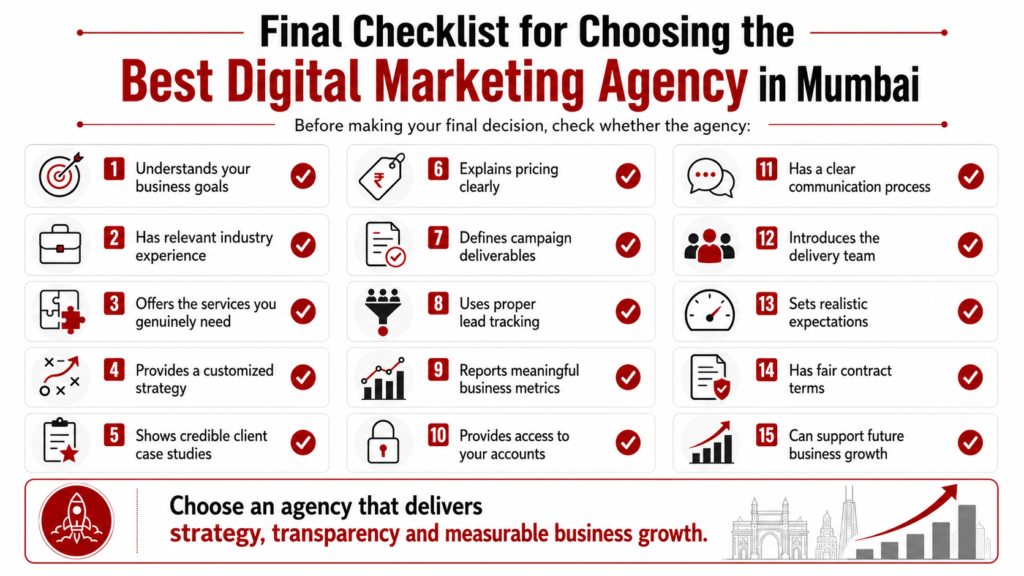
Before making your final decision, check whether the agency:
- Understands your business goals
- Has relevant industry experience
- Offers the services you genuinely need
- Provides a customized strategy
- Shows credible client case studies
- Explains pricing clearly
- Defines campaign deliverables
- Uses proper lead tracking
- Reports meaningful business metrics
- Provides access to your accounts
- Has a clear communication process
- Introduces the delivery team
- Sets realistic expectations
- Has fair contract terms
- Can support future business growth
The best digital marketing agency in Mumbai is not the one making the biggest promise. It is the one that asks the right questions, builds a suitable plan, measures meaningful results and communicates with transparency.
Frequently Asked Questions
1. How do I choose the best digital marketing agency in Mumbai?
Start by defining your goals, budget, target audience and required services. Compare agencies based on relevant experience, case studies, strategy, deliverables, account ownership, reporting, communication and measurable results. Do not choose an agency based only on price or promises.
2. What should I check before hiring a digital marketing agency?
Check the agency’s portfolio, client case studies, online reviews, industry experience, team structure, service scope, tracking methods, reporting process, pricing model, contract terms and ownership of marketing accounts.
3. How much does a digital marketing agency charge in Mumbai?
The cost varies according to the services, competition, content volume, advertising budget, campaign complexity, team expertise and reporting requirements. Ask for a customized proposal with clear deliverables, exclusions and additional charges.
4. What services should a digital marketing agency offer?
Depending on your needs, services may include SEO, local SEO, Google Ads, Meta Ads, social media marketing, content marketing, website development, landing pages, conversion optimization, email marketing, analytics and automation.
5. How can I verify a digital marketing agency’s results?
Ask for relevant case studies showing the original challenge, strategy, campaign period and business outcome. Review whether the agency reports qualified leads, conversion rate, cost per lead, revenue or return on ad spend—not only impressions and clicks.
6. What questions should I ask a digital marketing agency?
Ask who will manage the account, which services should be prioritized, how results will be tracked, what reports will include, who owns the accounts, what is included in the fee and how the agency handles underperforming campaigns.
7. How long does digital marketing take to show results?
The timeline depends on the service, competition, website condition, budget, offer and market. Paid advertising may begin generating data quickly, while SEO and content usually require sustained work. Avoid agencies offering guaranteed outcomes within fixed periods.
8. How do I measure digital marketing ROI?
Track the revenue or business value generated through marketing and compare it with total marketing costs. Also measure qualified leads, cost per lead, conversion rate, customer acquisition cost and return on ad spend where relevant.
9. Is a local digital marketing agency in Mumbai better?
A local agency may understand Mumbai audiences, neighbourhoods and competitive conditions more closely. However, location should be considered alongside expertise, transparency, processes and relevant experience.
10. Should a small business hire a full-service agency?
A digital marketing agency for small businesses in Mumbai can be useful when the business needs coordinated support across SEO, paid ads, content, social media, websites and tracking. The final choice should depend on goals, budget and internal capabilities.
Conclusion
Choosing a marketing partner is an important business decision.
Do not rush because an agency offers a low price, a long list of deliverables or an attractive sales presentation. Look deeper into its strategy, experience, tracking, team, communication and understanding of your business.
A capable digital marketing agency for business growth should connect marketing activities with measurable goals. It should help you understand where your leads come from, how campaigns are performing and what should happen next.
The right relationship is not based on unrealistic guarantees. It is built on clear expectations, useful reporting, consistent execution and shared accountability.
Are you looking for a professional and ROI-driven digital marketing agency in Mumbai?
Spidery Web helps businesses create practical digital strategies across SEO, local SEO, Google Ads, social media marketing, content, website optimization and marketing automation.
Speak with our team to discuss your goals, current challenges and the digital marketing services your business actually needs.