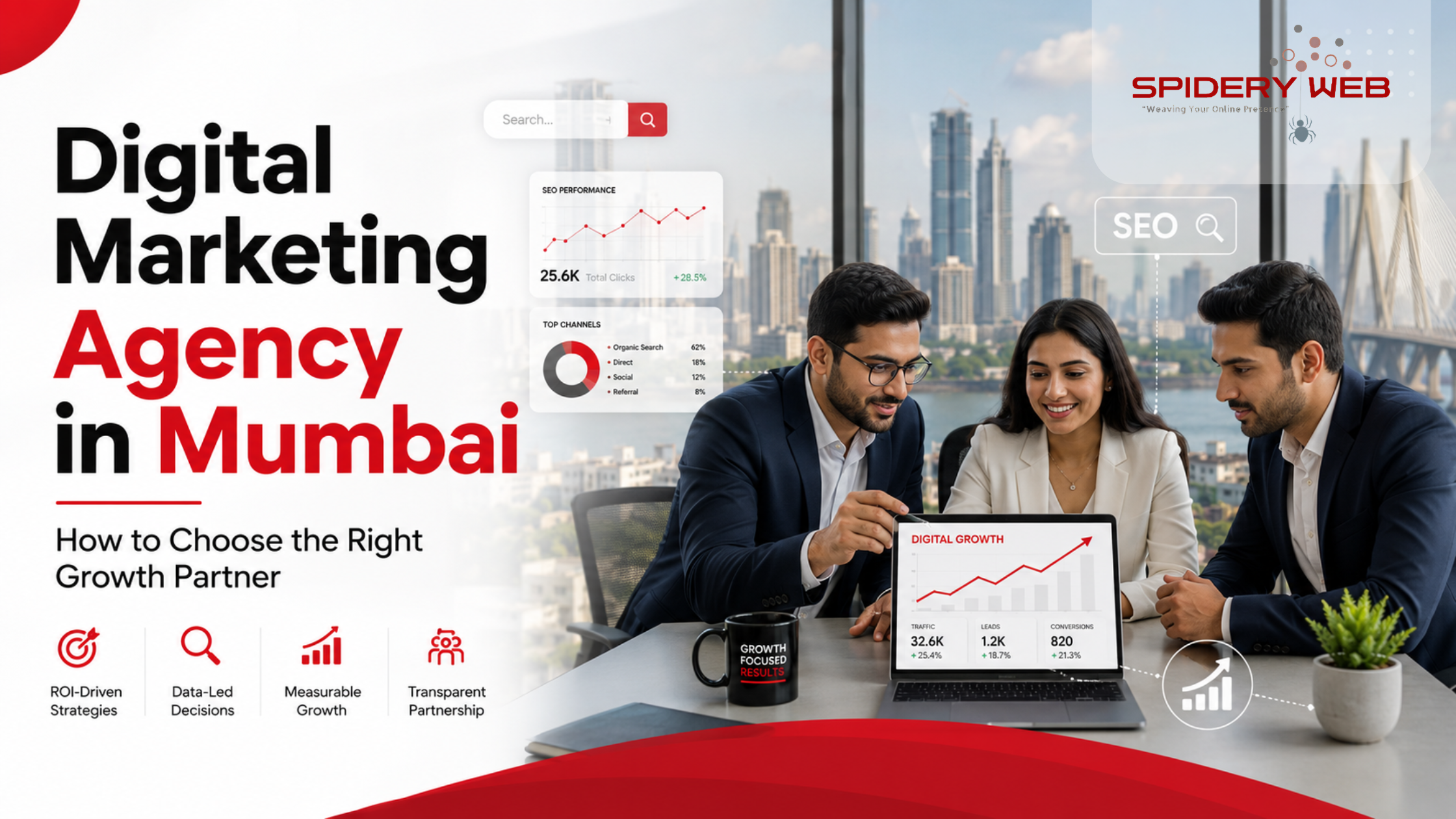
A digital marketing agency in Mumbai should help your business attract the right audience, generate qualified enquiries and understand which marketing activities contribute to growth. The right agency does more than post content or run advertisements. It connects strategy, creative work, technology, analytics and sales outcomes in one measurable plan.
That sounds simple. In practice, choosing an agency can be confusing.
Almost every agency offers SEO, Google Ads, social media marketing and website development. Many describe themselves as result-driven full-servic or the best. Those phrases do not tell you whether the agency is suitable for your business.
A startup may need rapid testing and a focused landing page. A local shop may need Google Business Profile optimisation and location-based advertising. A clinic may need trust-building content and appointment tracking. A manufacturer may need technical SEO, industry content and qualified B2B enquiries.
The correct strategy depends on your business, not on the agency’s standard package.
This guide explains how to compare digital marketing agencies in Mumbai, understand their services, evaluate proposals, protect your accounts and measure genuine business outcomes.
Quick Answer: How Do You Choose a Digital Marketing Agency in Mumbai?
Choose an agency that understands your business goals, target audience, sales process and local market. Ask for a customised strategy, clear deliverables, account ownership, conversion tracking, relevant work examples and transparent reporting. Avoid agencies that guarantee rankings, hide advertising accounts or focus only on traffic, impressions and followers.
Agency Selection Checklist
Before signing, confirm that the agency:
- Understands your business model
- Defines measurable goals
- Recommends only relevant services
- Explains who will work on your account
- Separates agency fees from advertising spend
- Gives you ownership or administrative access
- Sets up proper conversion tracking
- Defines a qualified lead
- Provides a clear reporting schedule
- Uses realistic timelines
- Shows relevant experience
- Explains contract and cancellation terms
- Connects marketing data with sales outcomes
What Does a Digital Marketing Agency in Mumbai Do?
A digital marketing agency plans and manages online activities that help a business become visible, attract potential customers and convert interest into enquiries or sales. Depending on the business, this may include SEO, Google Ads, Meta Ads, social media, websites, content, local SEO, analytics and conversion optimisation.
The agency should begin by answering four questions:
- Who is the ideal customer?
- What problem is the customer trying to solve?
- Where does that customer search or spend time online?
- What should happen after the customer discovers the business?
Without these answers, marketing becomes a list of disconnected activities.
You may receive more posts, clicks and website visitors without receiving better business opportunities.
What a Good Agency Should Manage
A capable agency may help with:
- Market and competitor research
- Customer persona development
- Keyword research
- Content planning
- Website structure
- Search engine optimisation
- Google Ads
- Meta and LinkedIn advertising
- Social media management
- Landing-page development
- Conversion tracking
- Google Business Profile optimisation
- Email or WhatsApp follow-up systems
- Reputation management
- Monthly analysis
- Campaign improvement
The exact combination should depend on your goals.
Who Should Hire a Digital Marketing Agency?
A business should consider hiring an agency when it needs specialised skills, consistent execution or better measurement but cannot build a complete internal team. Agencies are particularly useful for growing companies that need SEO, advertising, content, design, web support and analytics to work together.
Startups
Startups often need to test:
- Customer segments
- Offers
- Landing pages
- Advertising messages
- Lead quality
- Acquisition costs
A startup should not begin with every available channel. It should identify the shortest practical route from attention to conversion.
Local Shops
A local shop may benefit from:
- Google Business Profile optimisation
- Local landing pages
- Location-based advertisements
- Customer review processes
- Product or service posts
- WhatsApp or call tracking
The main goal is usually to reach nearby customers at the correct time.
Clinics and Healthcare Practices
A clinic may need:
- Service-specific pages
- Local SEO
- Doctor or practitioner information
- Educational content
- Appointment tracking
- Reputation management
- Clear medical disclaimers
- Easy calling and booking options
Trust is especially important. Aggressive claims can harm credibility.
Service Providers
Consultants, accountants, designers, repair companies, trainers and other service businesses often depend on enquiries rather than direct online purchases.
Their marketing strategy should focus on:
- High-intent keywords
- Proof of expertise
- Service-area visibility
- Case examples
- Consultation requests
- Lead qualification
- Follow-up
B2B Companies and Manufacturers
B2B buyers may take longer to make a decision.
A suitable strategy may include:
- Technical service or product pages
- Industry-specific content
- Specification information
- Case studies
- LinkedIn campaigns
- Search campaigns
- Downloadable resources
- CRM integration
- Lead-stage tracking
The agency must understand the difference between a form submission and a genuine commercial opportunity.
Which Digital Marketing Services Does Your Business Need?
The right service depends on the problem you are trying to solve. SEO is useful when people actively search for your service. Paid advertising is useful when you need controlled reach or faster testing. Social media helps with awareness and trust. A good website converts that attention into action.
| Business problem | Recommended starting point |
| Business does not appear on Google | SEO and local SEO audit |
| Need enquiries quickly | Search ads and a focused landing page |
| People visit but do not contact | Conversion-rate optimisation |
| Brand is unknown | Content and social media strategy |
| Leads are irrelevant | Targeting, keyword and qualification review |
| Shop needs nearby customers | Google Business Profile and local campaigns |
| Website is outdated | Website redesign with SEO planning |
| B2B sales cycle is long | Search, content, LinkedIn and lead nurturing |
| Marketing cannot be measured | Analytics and conversion-tracking setup |
| Business wants AI-search visibility | Strong entity, content and technical SEO foundations |
Search Engine Optimisation
SEO services in mumbai to improves the ability of search engines and users to understand, access and trust your website.
It may include:
- Keyword research
- Search-intent mapping
- Technical audits
- On-page optimisation
- Internal linking
- Content creation
- Local SEO
- Digital PR or relevant link acquisition
- Performance monitoring
SEO is most useful when customers already search for your services.
It is not a one-time act of placing keywords on a page.
Google recommends creating original, substantial and people-first content that helps readers achieve their goal.
Local SEO helps a business become visible to customers searching within a particular area.
Google explains that local results are mainly influenced by relevance, distance and prominence. Complete business information, appropriate categories, reviews and accurate location information can support local visibility. trategy may include:
- Google Business Profile optimisation
- Accurate business details
- Service descriptions
- Location pages
- Review management
- Local citations
- Local links
- Locally relevant content
- Website-to-profile consistency
- Call and direction tracking
Warning: Publishing dozens of thin location pages with nearly identical wording is not a useful local strategy. Each location page should provide genuinely relevant information.
Google Ads
Google Ads can place your business in front of people actively searching for a related service.
A strong search campaign requires:
- Intent-focused keywords
- Negative keywords
- Correct location targeting
- Relevant advertisements
- A suitable landing page
- Call and form tracking
- Budget controls
- Search-term reviews
- Ongoing optimisation
A campaign should not be judged only by clicks.
The business should examine:
- Qualified leads
- Cost per qualified lead
- Appointment rate
- Proposal rate
- Sale value
- Revenue or gross profit where available
Meta Ads
Meta Ads can help businesses reach audiences based on interests, behaviour, demographics or previous engagement.
They may be useful for:
- Brand awareness
- Local offers
- Events
- Visual products
- Lead generation
- Retargeting
- Ecommerce
- Educational campaigns
The advertisement, offer, form and follow-up process must work together.
A cheap lead is not valuable when the person is not genuinely interested.
Social Media Marketing
Social media marketing in mumbai to helps businesses maintain visibility, demonstrate personality, educate audiences and build trust.
A useful content system can include:
- Educational posts
- Reels
- Carousels
- Customer questions
- Behind-the-scenes content
- Case examples
- Offers
- Testimonials
- Team expertise
- Community engagement
Posting every day is not automatically a strategy.
Each post should support a defined purpose.
Website Design and Conversion Optimisation
A website should make it easy for the right visitor to understand the offer and take the next step.
Important elements include:
- Clear headline
- Relevant services
- Fast loading
- Mobile usability
- Trust signals
- Proof of experience
- Simple navigation
- Strong calls to action
- Contact options
- Useful FAQs
- Accurate tracking
A beautiful website can still fail when visitors cannot understand what the business offers.
AEO and GEO
Answer Engine Optimisation and Generative Engine Optimisation aim to make information clear, structured, credible and easy for search or AI systems to understand.
Useful practices include:
- Clear direct answers
- Strong entity information
- Descriptive headings
- Consistent business details
- Original examples
- Citable facts
- Author information
- Relevant internal links
- Accessible page structure
- Accurate structured data
These practices strengthen traditional SEO as well.
Google states that websites do not need special AI-only files or new machine-readable markup to participate in its AI search features. Standard technical and content best practices remain important. The Choose SEO or Paid Advertising First?
Choose SEO when your audience already searches for your service and you want to build long-term organic visibility. Choose paid advertising when you need faster market feedback, controlled targeting or immediate campaign testing. Many businesses benefit from combining both, but only when the budget, landing page and tracking system can support them.
| Factor | SEO | Paid advertising |
| Visibility | Builds gradually | Can begin after campaign approval |
| Payment model | Pay for strategy and execution | Pay agency fee and media spend |
| Long-term value | Content can continue attracting visitors | Traffic usually reduces when spend stops |
| Testing speed | Slower | Faster |
| Control | Less control over exact rankings | Greater control over targeting and budgets |
| Best use | Sustainable search visibility | Demand capture and rapid testing |
| Main risk | Weak content or poor technical execution | Wasted budget from poor targeting or tracking |
Practical Decision Rule
Start with paid search when:
- The offer is clear
- Search demand exists
- The landing page is ready
- Leads can be followed up quickly
- Conversion tracking is installed
Start with SEO when:
- The business has long-term goals
- Customers research before buying
- The site needs stronger authority
- Advertising costs are difficult to sustain
- The business can invest in useful content
Combine both when the company can manage lead follow-up and has enough budget to avoid underfunding every channel.
How Should a Mumbai Business Choose an Agency?
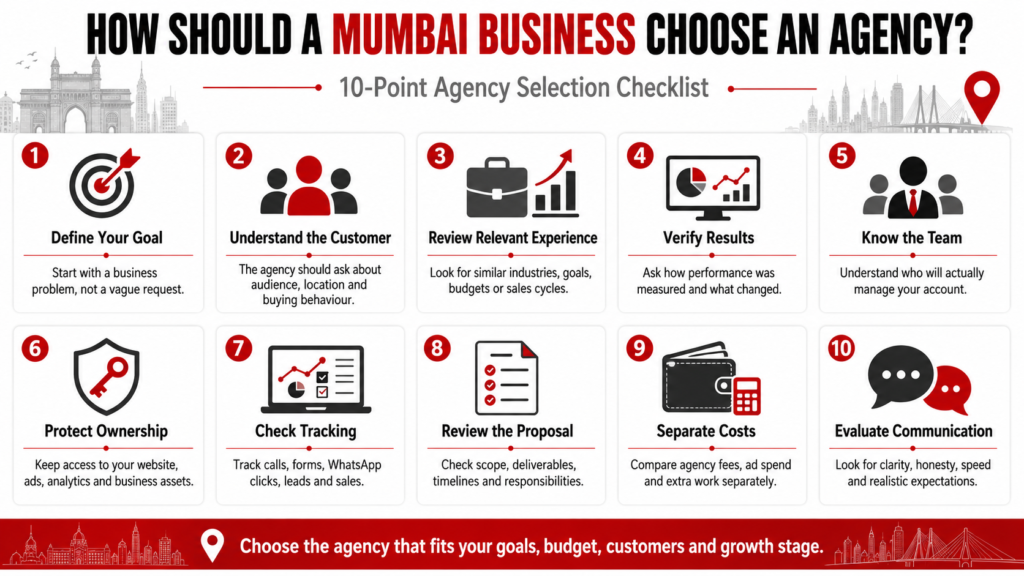
A Mumbai business should choose an agency by evaluating its strategy, relevant experience, transparency, tracking process and ability to understand local customers. The agency’s popularity matters less than whether its proposed work connects to your goals, budget, audience, sales process and operational capacity.
1. Define Your Goal Before Requesting a Proposal
Do not begin with:
“We need digital marketing.”
Begin with a business problem:
- We need 30 qualified consultation requests.
- We want more calls from customers within five kilometres.
- We need distributors for a specific product.
- We want to reduce our dependence on referrals.
- We want to improve online sales.
- We need better lead tracking.
A clear goal helps the agency recommend the correct channels.
2. Check Whether the Agency Understands Your Customer
The agency should ask questions about:
- Customer location
- Customer problems
- Average order value
- Sales cycle
- Buying objections
- Decision makers
- Seasonal demand
- Profit margins
- Current lead sources
- Follow-up process
An agency that recommends a package before understanding the business may be selling activities rather than solving a problem.
3. Review Relevant Experience
Ask for work related to:
- Your industry
- A similar sales cycle
- A similar location
- A similar business model
- A similar budget level
Relevant experience does not mean the agency must have worked with an identical company.
It should understand the practical challenges involved.
4. Ask How Results Were Calculated
A screenshot without context proves very little.
Ask:
- Which period is being compared?
- What was the starting point?
- Was advertising spend increased?
- Were leads qualified?
- How was revenue attributed?
- Did website changes contribute?
- What other activities were running?
- Were the figures independently verifiable?
Expert note: A responsible agency may anonymise client information. Confidentiality should not prevent it from explaining the process, measurement method and type of improvement.
5. Understand Who Will Work on Your Account
The person giving the presentation may not manage the campaign.
Ask about:
- Account manager
- SEO specialist
- Advertising specialist
- Content writer
- Designer
- Video editor
- Web developer
- Analytics specialist
Also ask:
- Who is the main contact?
- How quickly are questions answered?
- How often are meetings held?
- Who handles urgent issues?
- Who replaces an unavailable team member?
6. Protect Your Account Ownership
Your business should retain appropriate access to its important assets.
Confirm ownership of:
- Domain
- Hosting
- Website
- Google Business Profile
- Google Ads
- Meta Business Manager
- Google Analytics
- Search Console
- Tag Manager
- Email list
- CRM
- Creative files
- Customer data
Do not allow essential business assets to remain permanently inside an agency employee’s personal account.
7. Check the Tracking Plan
The agency should explain how it will track:
- Form submissions
- Phone calls
- WhatsApp clicks
- Appointment bookings
- Purchases
- Download requests
- Email enquiries
- Qualified leads
- Sales
Without reliable tracking, optimisation becomes guesswork.
8. Review the Proposal Carefully
A professional proposal should define:
- Objectives
- Target audience
- Target locations
- Services included
- Monthly activities
- Platforms
- Content quantity
- Advertising management
- Tracking setup
- Reporting schedule
- Meeting frequency
- Client responsibilities
- Agency responsibilities
- Contract period
- Payment terms
- Cancellation terms
- Exclusions
9. Separate Advertising Spend From Agency Fees
Ask for a written breakdown.
| Cost category | What to confirm |
| Agency fee | Strategy, management and execution included |
| Media spend | Amount paid directly to advertising platforms |
| Creative production | Posts, banners, reels, photography or video |
| Website work | Landing pages, development and maintenance |
| Tools | Reporting, call tracking or automation platforms |
| Taxes | Whether quoted fees include applicable taxes |
| Additional work | Cost of work outside the monthly scope |
Never compare proposals using the final total alone.
Compare what each total includes.
10. Evaluate Communication Before Signing
Observe the agency’s behaviour during the sales process.
Does it:
- Ask useful questions?
- Explain terms clearly?
- Respond on time?
- Admit uncertainty?
- Provide realistic expectations?
- Send written summaries?
- Respect your budget?
- Avoid pressure tactics?
The sales experience often reveals how the account may be managed later.
Agency Versus Freelancer Versus In-House Team
An agency is suitable when a business needs several connected skills. A freelancer may be suitable for a clearly defined task. An in-house team offers deeper daily involvement but requires recruitment, management and multiple roles. The best option depends on workload, budget, complexity and the need for specialist expertise.
| Factor | Agency | Freelancer | In-house |
| Skill range | Usually broad | Usually specialised | Depends on team size |
| Availability | Shared team resources | Depends on one person | Dedicated working hours |
| Management | Agency manages specialists | Client may manage coordination | Business manages employees |
| Scalability | Easier to add services | Limited by capacity | Requires hiring |
| Business immersion | Requires strong onboarding | Varies | Usually high |
| Cost structure | Retainer or project | Project or monthly fee | Salaries, tools and hiring |
| Best for | Integrated campaigns | Specific deliverable | Continuous high-volume needs |
Choose an Agency When
- You need SEO, advertising, content and design together.
- You need backup resources.
- You want strategic oversight.
- You lack internal marketing management.
- You need to scale activity.
Choose a Freelancer When
- The task is narrow and well defined.
- You can manage the project internally.
- The work does not require several specialists.
- The workload is limited.
Build In-House When
- Marketing is a core daily function.
- The workload supports full-time specialists.
- The business can manage hiring and training.
- Internal product knowledge is essential.
A hybrid model is also possible. An internal marketing manager may coordinate specialist agency support.
How Much Does a Digital Marketing Agency in Mumbai Cost?
There is no responsible single price for digital marketing because the scope can vary from one local SEO campaign to a complete strategy involving advertising, content, video, development and analytics. A useful proposal should explain the work, team, advertising spend, production costs, tools, taxes and expected reporting process separately.
Factors That Affect Cost
- Number of services
- Competition
- Target locations
- Website condition
- Content requirements
- Advertising budget
- Creative complexity
- Number of products or services
- Reporting needs
- Technology integrations
- Campaign speed
- Team seniority
Compare Value, Not Deliverable Count
A proposal with 30 social posts is not automatically better than one with 12.
Ask:
- What purpose does each activity serve?
- Who creates it?
- How is quality checked?
- How does it support conversions?
- What will be measured?
- What happens when it does not perform?
What Should Happen During the First 90 Days?
The first 90 days should establish a reliable foundation, launch priority activities and create enough data for informed optimisation. It is not a universal deadline for achieving every result. The sequence will differ by channel, but strategy, access, tracking, research and execution should become progressively clearer.
The Days 1–30: Discovery and Foundation
- Business discovery
- Audience research
- Competitor review
- Website audit
- Analytics audit
- Account access
- Conversion tracking
- Keyword research
- Offer review
- Strategy preparation
- Content planning
- Approval process
Days 31–60: Launch and Testing
- Priority website improvements
- Campaign setup
- Landing-page launch
- Content publication
- Local SEO improvements
- Advertising tests
- Search-term reviews
- Audience testing
- Creative testing
- Lead-quality review
Days 61–90: Optimisation and Expansion
- Analyse early performance
- Remove weak targeting
- Improve advertisements
- Improve landing pages
- Expand useful keywords
- Update content
- Review lead quality
- Connect marketing and sales data
- Adjust budgets
- Prepare the next-quarter plan
Warning: Immediate activity is not the same as immediate business impact. Search visibility, customer trust, sales cycles and internal follow-up all affect results.
Which Metrics Should Your Agency Report?
A digital marketing agency should report metrics that connect activity with business outcomes. Traffic, reach and engagement provide context, but they should not replace lead quality, conversion rate, acquisition cost, appointment rate, sales value or return on investment when those figures can be measured responsibly.
Awareness Metrics
- Reach
- Impressions
- Video views
- Branded searches
- Profile visits
- New users
Engagement Metrics
- Click-through rate
- Time on page
- Scroll depth
- Social interactions
- Saved posts
- Returning visitors
Lead Metrics
- Total leads
- Qualified leads
- Invalid leads
- Cost per lead
- Cost per qualified lead
- Lead source
- Appointment bookings
- Proposal requests
Sales Metrics
- Sales-qualified leads
- Conversion rate
- Closed sales
- Average sale value
- Revenue
- Gross profit where available
- Return on advertising spend
- Marketing return on investment
Define a Qualified Lead
A qualified lead should meet agreed criteria such as:
- Correct location
- Relevant service requirement
- Suitable budget
- Genuine contact details
- Valid timeline
- Decision-making authority
- Reachable by the sales team
Marketing and sales teams should review lead quality together.
What Are the Warning Signs of a Poor Agency?
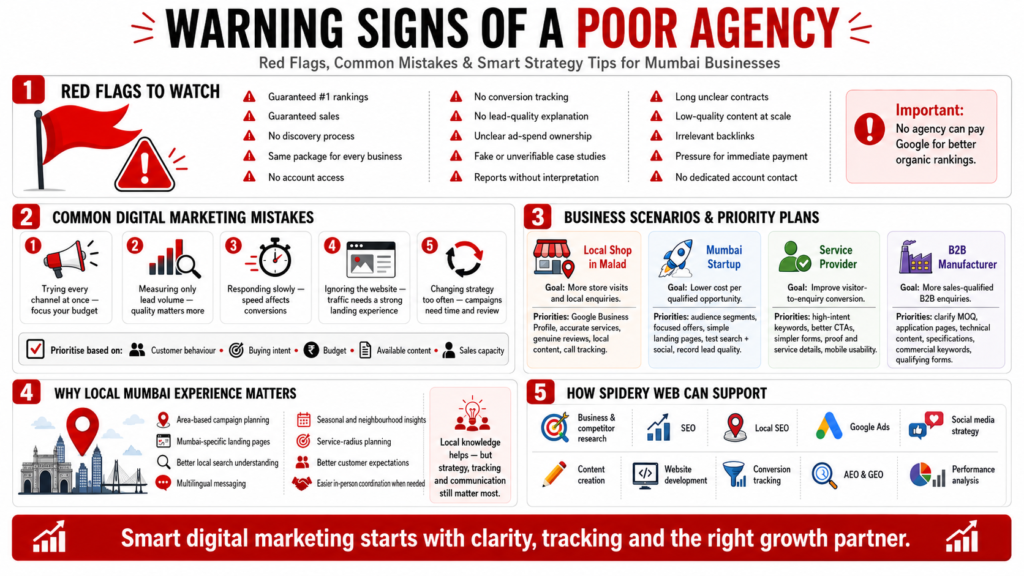
Warning signs include guaranteed rankings, hidden accounts, unclear deliverables, copied strategies, poor communication, fabricated urgency and reports focused only on vanity metrics. One warning sign may have an innocent explanation. Several warning signs together usually justify a deeper review before signing or renewing the contract.
Red Flags
- “Guaranteed number-one ranking”
- “Guaranteed sales”
- No discovery process
- Same package for every business
- Refusal to provide account access
- No conversion tracking
- No explanation of lead quality
- Unclear advertising-spend ownership
- Fake or unverifiable case studies
- Reports without interpretation
- Long contracts with unclear cancellation terms
- Large quantities of low-quality content
- Irrelevant backlinks
- Pressure to make an immediate payment
- No named account contact
Google states that businesses cannot request or pay Google for better local rankings. Be cautious when an agency implies that it has special access to organic results. ital Marketing Mistakes Businesses Make
Businesses often blame the platform when the real problem is unclear positioning, poor tracking, weak follow-up or an unsuitable offer. Digital marketing amplifies what already exists. It cannot permanently fix a confusing service, uncompetitive pricing, slow response times or a sales process that ignores enquiries.
Mistake 1: Trying Every Channel at Once
Spreading a small budget across SEO, Google Ads, Meta Ads, LinkedIn, YouTube and influencer campaigns may prevent any channel from receiving enough attention.
Prioritise based on:
- Customer behaviour
- Buying intent
- Budget
- available content
- Sales capacity
Mistake 2: Measuring Only Lead Volume
One campaign may generate 100 poor leads. Another may generate 15 highly relevant enquiries.
Measure quality, not only quantity.
Mistake 3: Responding Slowly
The agency may generate enquiries, but the business must respond properly.
Set:
- Lead-assignment rules
- Response-time standards
- Follow-up reminders
- Lead-stage tracking
- Lost-lead reasons
Mistake 4: Ignoring the Website
Sending paid traffic to a slow or confusing page wastes opportunities.
Advertising and website experience should be reviewed together.
Mistake 5: Changing Strategy Too Frequently
Campaigns need review, but constant unplanned changes make learning difficult.
Agree on:
- Test period
- Success criteria
- Review date
- Decision rules
Illustrative Business Scenarios
The following examples demonstrate strategy choices. They are not presented as fabricated client case studies.
Scenario 1: A Local Shop in Malad
Problem: The shop depends on walk-ins and referrals.
Priority plan:
- Improve Google Business Profile information.
- Add accurate products or services.
- Request genuine customer reviews.
- Create location-relevant website content.
- Track calls and direction requests.
- Test a limited-radius campaign.
Main metric: Store visits, calls and local enquiries.
Scenario 2: A Mumbai Startup
Problem: The startup does not know which customer segment will convert.
Priority plan:
- Define two or three audience segments.
- Create one focused offer for each.
- Build simple landing pages.
- Test search and social campaigns.
- Record lead quality.
- Improve the strongest combination.
Main metric: Cost per qualified opportunity.
Scenario 3: A Service Provider
Problem: Website traffic is increasing, but enquiries remain low.
Priority plan:
- Check whether keywords match buying intent.
- Review calls to action.
- Simplify forms.
- Add proof and service details.
- Improve mobile usability.
- Track calls, forms and WhatsApp actions.
Main metric: Visitor-to-enquiry conversion rate.
Scenario 4: A B2B Manufacturer
Problem: The company receives irrelevant retail enquiries.
Priority plan:
- Clarify minimum order quantities.
- Publish application-specific pages.
- Use technical language buyers understand.
- Add specifications and documentation.
- Target commercial keywords.
- Qualify leads through forms.
Main metric: Sales-qualified B2B enquiries.
Why Does Local Mumbai Experience Matter?
Local experience is useful when the agency understands customer language, service areas, travel patterns, neighbourhood competition and how local buyers compare businesses. However, location alone does not prove quality. A Mumbai agency must still demonstrate good strategy, tracking, communication and relevant execution.
Local knowledge may help with:
- Area-based campaigns
- Mumbai-specific landing pages
- Local search behaviour
- Multilingual messaging
- Local events
- Seasonal demand
- Service-radius planning
- Customer expectations
- Photography and production coordination
- In-person meetings when necessary
Google’s local system considers relevance, distance and prominence. Therefore, strong local information should be accurate and useful rather than a collection of repeated neighbourhood names. idery Web Support Mumbai Businesses?
Spidery Web is a digital marketing agency based in Malad West, Mumbai. Its website presents services including SEO, PPC, social media marketing, content marketing, website development and online reputation management for startups, small businesses and other industries. The correct engagement should still begin with a business-specific audit and strategy. idery Web plan may include:
- Business and competitor research
- SEO
- Local SEO
- Google Ads
- Social media strategy
- Content creation
- Website development
- Conversion tracking
- AEO and GEO
- Performance analysis
The objective should not be to sell every service.
It should be to identify which activities can make the greatest practical contribution to the client’s goal.
conclusion
Begin by writing down one business outcome, one target audience and one priority location. Then request a strategy that explains the channels, deliverables, tracking system, responsibilities, costs and review process. Compare agencies on clarity and suitability not only presentation quality, follower counts or promises.
Before Contacting an Agency
Prepare:
- Business overview
- Priority service
- Target customer
- Target location
- Current website
- Current marketing accounts
- Previous performance data
- Monthly budget range
- Sales process
- Main challenge
- Desired outcome
During the Consultation
Ask:
- What should we prioritise first?
- What should we avoid?
- How will you measure qualified leads?
- What access will we receive?
- Who will manage the account?
- What is included and excluded?
- What happens during the first month?
- How will weak performance be handled?
- How often will we meet?
- How can our sales team support the campaign?
Before Signing
Confirm everything in writing.
A good agency relationship is built on:
- Clear goals
- Honest expectations
- Transparent access
- Reliable communication
- Proper tracking
- Shared responsibility
- Continuous learning
Frequently Asked Questions
1. What does a digital marketing agency in Mumbai do?
It helps businesses attract and convert customers through services such as SEO, paid advertising, social media, content, website development, local SEO and analytics. The exact work should depend on the business goal.
2. How do I choose the best digital marketing agency in Mumbai?
Compare strategy, relevant experience, communication, tracking, account ownership, deliverables and reporting. Avoid selecting an agency only because it calls itself the best or offers the largest number of activities.
3. Is Spidery Web located in Mumbai?
Yes. Spidery Web’s website lists its office in Malad West, Mumbai. Confirm current meeting arrangements directly before visiting. cal agency better than a remote agency?
Not automatically. A local agency may understand the market and support in-person coordination, but strategy, expertise, communication and reporting remain more important than distance alone.
5. How much does a digital marketing agency charge?
Pricing depends on scope, competition, channels, content, advertising budgets, website requirements and reporting needs. Request a written breakdown rather than relying on one headline price.
6. Is advertising spend included in the agency fee?
Sometimes, but often it is separate. The proposal should clearly distinguish platform spend, management fees, content production, development, tools and taxes.
7. Should a startup hire a digital marketing agency?
A startup may benefit from an agency when it needs rapid testing and several specialist skills. It should begin with a narrow plan rather than purchasing every service.
8. Can a small shop benefit from digital marketing?
Yes. Local SEO, Google Business Profile, customer reviews, location-based advertisements and WhatsApp or call tracking can help a shop reach nearby customers.
9. Which is better: SEO or Google Ads?
SEO supports long-term organic visibility, while Google Ads enables faster testing and controlled placement. The better option depends on urgency, budget, search demand and website readiness.
10. How long does SEO take?
There is no universal timeline. Website condition, competition, content quality, technical issues and search demand all affect progress. Ask for milestones instead of guaranteed ranking dates.